
UNIMOTHER 1 on 1 Aionic Antifragile System Consulting - 99€/h
UNIMOTHER 1 on 1 Aionic Antifragile System Consulting - 99€/h
Couldn't load pickup availability
There Is No Waste — Only Unused Raw Materials
There Is No Waste — Only Unused Raw Materials
In nature, nothing is truly wasted - everything transforms. At Unimother, we embrace that principle: what others discard, we see as building material. By reusing and reimagining materials, we reduce environmental harm and close the loop. Waste isn’t a burden - it’s a resource waiting for purpose. This mindset turns landfills into opportunities, lowers costs, and protects ecosystems. There is no “waste”. Only cycles waiting to be completed
Every Dollar We Spend We Choose The World We Live In
Every Dollar We Spend We Choose The World We Live In
You as a Consumer have the biggest power and leverage over any business. Every purchase is a choice - a vote for the world we want tomorrow. When we spend money, we fund the values behind the product: how it’s made, who made it, and its impact on nature. We can build clean water, fertile soil, fair work, and thriving communities through conscious buying. Every transaction either fuels destruction or empowers change. Your money carries weight - use it to build the future you believe in.
Money Back Or Money Back
Money Back Or Money Back
Trust is earned, not demanded. If you’re not happy with what you receive or the product doesn't make you your money back, we give you your money back. No hidden conditions. No endless forms. Just respect. We believe in what we create - and that belief is backed by action. Your experience matters more than the transaction. When we say zero risk, we mean it. You either love it, or we make it right. Simple as that. Because real impact starts with trust and ends with integrity.
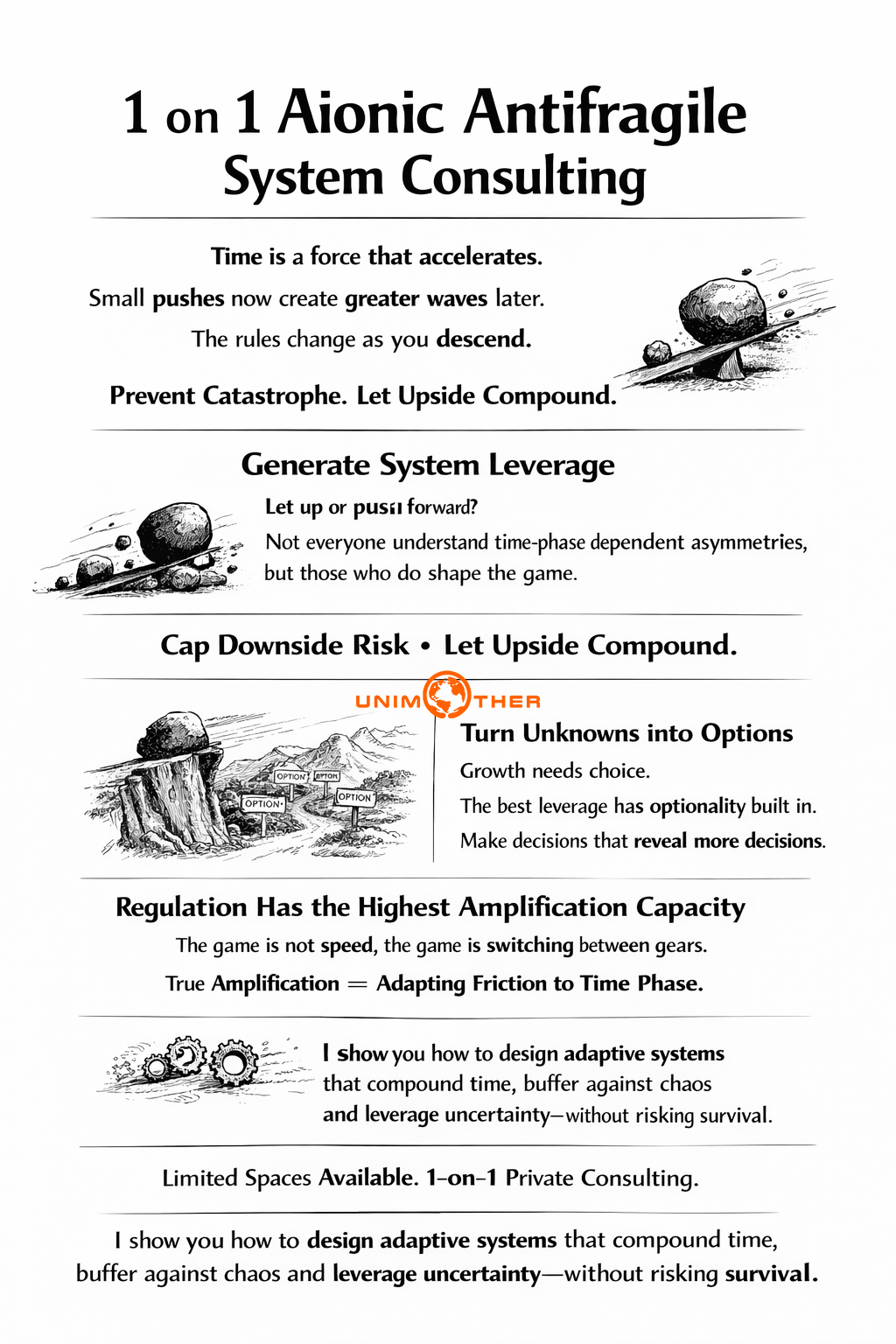
Designing time-stable systems with asymmetric risk-reward.
Compounding Time
Time behaves like a stone rolling down a mountain:
It’s a force that accelerates once it’s set in motion.
What takes time, you have to start early. Anything else can wait.
Small pushes early create unstoppable forces later
It’s accelerating — depending on what you set in motion.
Early direction matters more than speed because of compounding effects.
If you stop moving, momentum leaves you behind.
Thats why you have to avoid hitting something thats stops your movement completely.
If you’re the first to reach the bottom it's also over. You never want to win the race to the bottom.
Be the first to set other stones in motion —
and the last to reach the bottom.
Paid Ads = Carrying stones down a hill
Organic Strategy Systems = hitting other stones while still being in high altitude of time, letting the total amounts of bets multiplied by gravity do the work
Most businesses gamble.
I redesign the game.
The biggest mistake companies make is working hard all the time
Work Hard / Move Fast — properly understood
The mistake with “work hard” or “move fast” is not that they’re wrong —
it’s that they’re sold as a permanent state.
Systemically, this is more accurate:
Work has phases.
Speed is a tool, not a value.
When speed / intensity is correct
There are moments where pressure and tempo are necessary:
-
Thresholds (launches, deadlines, crises)
-
Time windows (market shifts, opportunities, momentum)
-
Irreversible decisions (commitments)
-
Execution after clarity is achieved
Here:
-
Hesitation costs more than mistakes
-
Speed reduces risk and increases opportunities
When the opposite is correct
There are phases where slowness is objectively superior:
-
Thinking and structuring
-
System design
-
Option evaluation
-
Stabilization
-
Reducing friction
-
Recovery and distance
-
Optimizing your system for when the next opportunities arrive - if you skip this you will run on fragile foundations the next run
Here:
-
speed creates blindness
-
pressure distorts priorities
-
“hard work” amplifies wrong assumptions
Slowness here is precision, not luxury.
The rare meta-skill
Speed, force, and intensity only become advantages when a system can regulate them.
Not:
-
always working hard ❌
-
always moving fast ❌
But:
knowing which regime applies — and switching deliberately.
Most people don’t fail from laziness,
but from operating in the wrong mode.
Time-stable systems switch modes.
Fragile systems live in permanent stress.
Why Regulation has the Highest Power of Leverage from the Aionic Frame
True power is not the ability to push harder,
but the ability to regulate when to push,
when to slow down,
and when to do nothing.
Aionic principle
Unregulated force destroys systems over time.
Regulated force compounds.
Antifragile implication
-
Speed without regulation → fragility
-
Intensity without buffers → collapse
-
Constant effort → loss of optionality
Systemic rule
Only systems that can regulate stress
retain the capacity to act under unforeseen stress.
Offseason is not rest. It is system maintenance and preparation for the next playoffs.
Off-season
-
rebuild buffers
-
fix weak links
-
train new techniques
-
expand range and optionality
-
experiment without consequence
Time-stable formulation
Regulation preserves reserves.
Reserves preserve freedom.
Freedom determines outcomes under pressure.
Regulation is the highest form of leverage.
Why permanent stress destroys systems
Even antifragile system can only handle a certain amount of stress before they break. They still need time to adapt to their stressors
The mistake most systems make
They train on-season all the time:
-
constant output
-
no repair window
-
no capacity growth
That’s not hard work — it’s mode confusion.
Stress without recovery is not training —
it’s capital destruction.
Permanent stress:
-
consumes buffers (energy, attention, health)
-
distorts decisions (short-term bias)
-
confuses urgency with importance
-
turns systems reactive instead of capable
The result:
-
lots of movement
-
little effect
-
no reserves when it actually matters
What real stress actually is
Real stress is:
-
rare
-
time-limited
-
decisive
-
often irreversible
Crisis. Launch. Turning point. Danger. Disease
It requires:
-
clear perception
-
physical energy
-
decision freedom
-
the ability to act fast
And that is exactly what permanent stress eliminates.
Buffers are not inefficiency.
Buffers are survivability.
Time-stable systems:
-
operate calmly
-
may look slow
-
accelerate explosively when required
Fragile systems:
-
run at the limit
-
look busy
-
collapse under unpredictable load
All In Bets
Another often fatal mistake business owners make is betting too much on the wrong things.
One big bet.
One rigid plan.
One assumption that has to be true.
That’s not ambition.
That’s russian roulette.
What I actually do
I help reverse the risk–reward equation.
Instead of:
-
high risk / uncertain reward
-
single points of failure
-
all-in decisions
I design:
-
low-risk, high-upside moves
-
many small, independent bets
-
structures where failure is cheap, and learning is fast
The goal is simple:
Cap downside.
Let upside compound.
Why this works
Profit is limited.
Workers are limited.
Achievable work per month is limited.
Losses are not.
So the smartest strategy is not to chase the biggest upside —
It’s to remove the possibility of catastrophic loss.
Being Antifragile.
Bottom Up Approach.
When downside is capped:
-
You can move faster
-
You can test more ideas
-
You don’t freeze decisions out of fear
-
One win can pay for many failures
-
You can learn from many mistakes and adapt
-
You can integrate errors into your system for more antifragility
That’s how durable businesses are built.
Antifragile systems:
-
Improve Systems by integrating errors
-
Use turbulence to move forward instead of fighting them
-
require little constant input, but respond well to impulses
-
work through relationships, not control
Across nature, technology, and organizations:
-
Redundancy beats efficiency
-
simplicity beats maximization
-
time beats optimization
A system is good when it can function for a while without you.
How this applies in practice
Depending on the situation, this can mean:
-
breaking one large decision into multiple smaller ones
-
restructuring production to fail safely
-
testing demand before scaling supply
-
designing optionality instead of commitments
-
killing ideas early while they’re still cheap
This is NOT theory.
It’s risk engineering.
The principle behind all of this
You don’t win by being right once.
You win by not being wrong in a way that kills you —
while giving yourself many chances to be right.
That’s the work.
The real cause of death of strong systems
Not:
-
lack of innovation ❌
-
insufficient capital ❌
-
lack of talent ❌
But:
Loss of the system’s self-understanding.
Specifically:
-
They don’t know what actually makes them strong
-
They can’t articulate it
-
Therefore, they can’t defend it
-
And they start optimizing the wrong things
That is systemic suicide, not market failure.
The Classic Pattern (always the same)
-
The system works well
-
Success creates options
-
Options create distractions
-
Distraction dilutes the core
-
The core becomes interchangeable
-
The system dies despite having resources
It’s not competition that destroys the system,
but its own lack of clarity about its leverage.
Why This Hits Strong Systems in Particular
Weak systems:
-
have little to lose
-
focus instinctively
Strong systems:
-
can afford many things
-
experiment too broadly
-
confuse activity with progress
And that’s exactly where they lose their strength.
It’s more important to know what you have than to have it
Here’s why that holds across systems:
1) What you have is blindness without awareness
Resources, AI, workers, machines, skills, time, health, relationships, capital, reputation—
they don’t act by themselves.
If you don’t recognize them:
-
they don’t compound
-
they don’t get protected
-
they get spent solving the wrong problems
-
or worse: traded away cheaply
Most losses aren’t theft.
They’re dismissed through ignorance.
2) Awareness turns static assets into leverage
The moment you know what you have, three things happen:
-
you stop chasing substitutes
-
you stop overpaying for what you already possess
-
you start designing around strengths instead of compensating for imagined weaknesses
That’s when:
-
time becomes an asset instead of a pressure
-
constraints become filters instead of limits
-
simplicity becomes power instead of lack
3) Systems collapse when they forget their own strength
This is the pattern:
-
the system works
-
success creates options
-
options create distraction
-
distraction dilutes the core
-
the system forgets what actually made it strong
-
then it “optimizes” the wrong things
-
and dies rich, busy, and confused
That’s not failure of resources.
That’s failure of self-understanding.
4) Knowing what you have is a defensive skill
Once you know what matters:
-
you protect it
-
you buffer it
-
you leverage it
-
you refuse trades that endanger it
-
you say no faster
-
you move less, but with force
This is why:
Regulation beats force.
Because regulation requires knowing what must not be lost.
5) The uncomfortable corollary
People who don’t know what they have:
-
work harder than necessary
-
accept unnecessary risk
-
feel permanently behind
-
and are easily manipulated by urgency
They don’t lack assets.
They lack orientation.
The clean formulation
Possession is a burden.
Recognition is a resource.
Only recognition creates durability.
Or even sharper:
You don’t lose what you lack.
You lose what you fail to recognize.
The Aionic Correction
A system doesn’t need to be able to do everything.
It needs to be able to do the things that must never be lost.
Aionically formulated:
The most important function of a strong system
is preserving its own strength over time.
Everything else is secondary.
The Best Time to Plant a Tree Is Yesterday
As you know, only time is the limit.
Your time = extremely scarce
Compounding time = even scarcer
Bad decisions = damage x time x money x opportunity cost x compounding loss + missed opportunities x compounding interest
Delay = compounding loss
Avoid irreversible loss.
The right decision in the beginning can set you up for winning by being the steady foundation you build on.
While a bad decision can cause problems for years, decades, and even centuries down the line, you have to keep investing rare resources to fix and maintain.
Time is finite.
Errors are infinite.
Bad decisions are compoundingly expensive.
Most people underestimate what a wrong decision really costs.
It’s not just money.
It’s:
-
can be a money sink if not detected
-
cost years of wasted work and time to fix
-
constant mental load just to maintain the business
-
second-guessing and reverting back decisions can cause more delays, chaos, and damage
-
fixing structural mistakes that should never have existed can be exponentially expensive when you’ve already built systems around those errors.
-
burning brainpower just to repair something that could’ve been avoided
-
fatal mistakes can mean the end of your business
Once momentum is gone, it rarely comes back or takes enormous amounts of work to regain.
If you already know that grinding harder won’t fix a broken decision,
This is for you.
One simple truth
You can always earn more money.
You cannot earn back wasted time.
And fixing the wrong decision costs more than making the right one early.
That’s what you’re paying for.
Pricing
Private 1-on-1 Aionic Antifragile System Consulting
3333 €/hour
Sessions available in 60-minute packages.
Pricing adjusts with demand and availability.

Unimother
UNIMOTHER [Website + Blog + Social Media Content Package] Organic Online Trust Marketing Agency - Online Growth Engine That Makes Your Business Money 24/7